Skip to content

Watch: Leading your work and life with purpose

                                                            Will

Career disillusionment is not a new phenomenon. But it is becoming more visible, and it is arriving earlier. More professionals across industries are finding that the titles, the achievements and the stability they worked for are not producing the sense of meaning and fulfilment they expected. That gap between external success and internal satisfaction is what this session is about.

I
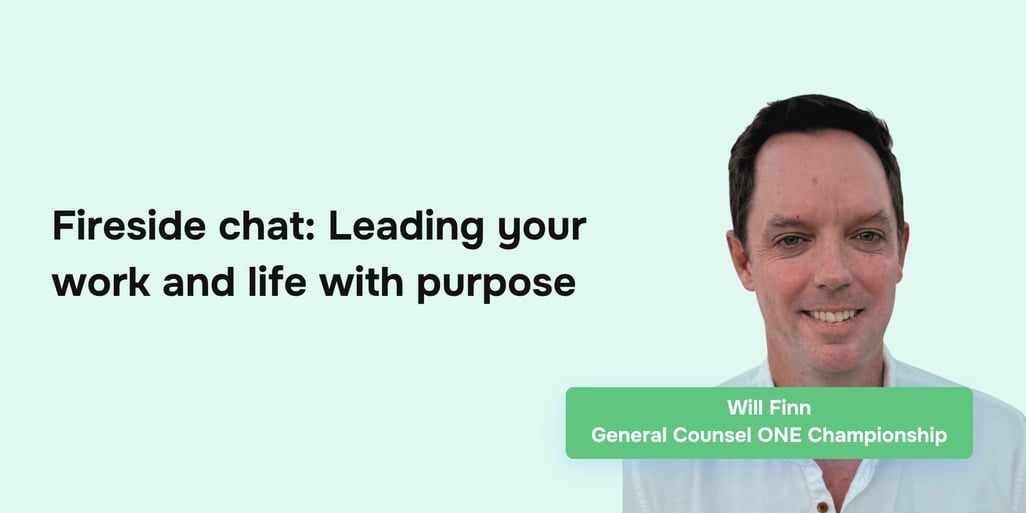
n this fireside conversation, Anurag, co-founder and CEO of Outsized, speaks with Will Finn, general counsel at ONE Championship and a researcher and teacher in Positive Psychology at the Viktor Frankl Institute, on the psychology of purpose, the danger of attaching identity to your employer and the practical ways to create space for meaning, even when your work is consuming everything.

Watch the full recording here:

What you'll take away from the session:

  •  Why career disillusionment is spreading across experience levels, and what the psychological research says about why this is a natural part of the human journey rather than a personal failing

  • The problem with attaching your identity and sense of worth to an employer, and why that attachment tends to destabilise when a career changes

  • Why purpose is not something you chase directly, and what Viktor Frankl and Irvin Yalom both agreed about how meaning actually arrives

  • How to hold a dissatisfying role in the right proportion, using Anurag's own experience of putting difficult work "in a box" to free up energy for what matters

  • Why the advice to quit everything and follow your passion can substitute one problem for another, and what a more sustainable approach actually looks like

  • How to distinguish burnout caused by overwork from the deeper signal of misalignment with your career path

  • What it means to pursue purpose from a place of wholeness rather than from a sense of lack, and why the starting point has to be self-reflection before action 


This is a candid, personal conversation between two people who have both navigated the questions they are discussing. It is for any professional who has achieved what they set out to achieve and found it was not quite enough.

Hit play and start with the question most people avoid asking. 

How do you find space for meaning when your job is consuming all your time and mental energy?

Will's answer is that the question tends to get avoided precisely because it is inconvenient. Being busy functions as a defence against the existential discomfort of asking whether what you are doing matters. His practical recommendation is stillness, in whatever form that takes: walking without a phone, sitting without stimulation, creating the conditions where the inner voice that is trying to guide you can actually be heard. He references Steve Jobs, who made significant business decisions based on intuition, and the common experience of having a breakthrough thought in the shower. The practical implication is that the starting point is not action but spaciousness. John Grisham wrote his first novel at four in the morning before beginning his workday as a lawyer. Creating even a small container of time for the thing that matters is often more viable than waiting for the perfect moment to pursue it fully. 

How do you know when what you are feeling is burnout versus a deeper signal that your career no longer fits?

Will's answer is: listen to your body. He draws on his own experience of going through cancer treatment as a moment that made it unmistakably clear that the path he had been on was not the only one he should be pursuing. The more common signal is cyclical: the pattern of burning out, recovering, returning and burning out again. Anurag adds that burnout is usually framed as a physical condition, but most of the cases he has encountered begin as a mental one: the absence of joy and connection to the work, which the mind then transmits to the body as exhaustion. If you are recovering physically but returning to the same sense of disconnection, the message is not about rest. It is about alignment. 

Do you have to leave your job to pursue purpose, or can the two co-exist?

They can co-exist, and Will argues that forcing a binary choice is often counterproductive. His clearest example is the JFK and the janitor story: a person sweeping floors at Cape Canaveral during the moon programme who understood themselves to be helping put a man in space. Purpose can be found in how you show up to whatever you are doing, not only in the category of work you are doing. The more practical dimension is Anurag's: leaving everything at once to pursue something meaningful can create economic pressure that takes the joy out of the very thing you left for. Anurag's approach is to put the dissatisfying work in a box, minimise its emotional weight, and use the stability it provides to build toward something better incrementally. That transition does not have to be dramatic. It does have to be deliberate. 

How do you advise someone who is earlier in their career and already asking whether their work has meaning?

Both Anurag and Will agree that the direction younger professionals are moving in is worth taking seriously, even if it creates its own challenges. Will's advice is not to look externally for an organisation that will provide the meaning, because that tends to produce disillusionment when the organisation turns out to be as commercially driven as any other. His recommendation is to start with what problems you genuinely want to solve, because entrepreneurialism at its core is problem solving and it is likely to become more accessible as AI absorbs the more routine parts of professional work. Anurag's advice is more practical: do not be driven by comparison, make active choices rather than passive ones, focus on the characteristics of work you want rather than a job title, and in the early years invest in experiences, knowledge and people rather than primarily in wealth accumulation.