Skip to content

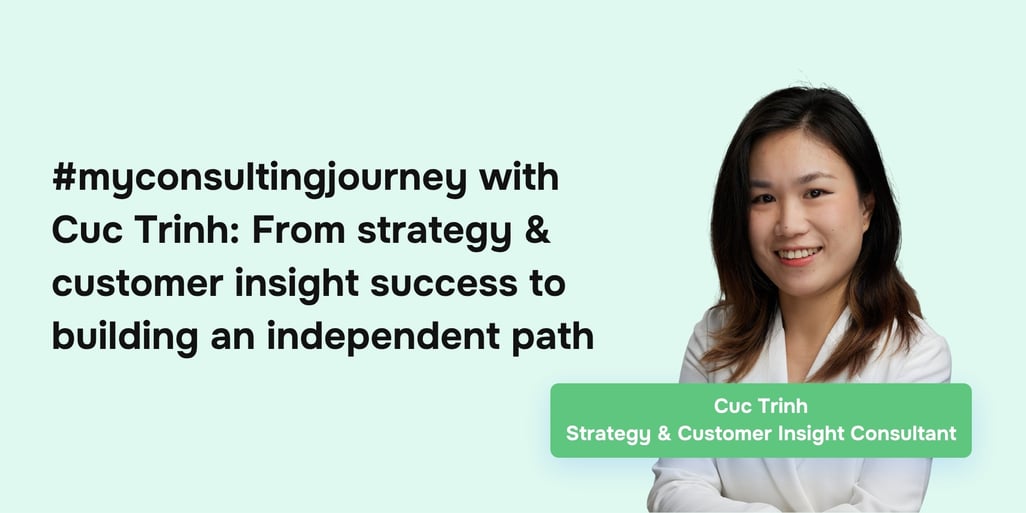
Watch: From strategy and customer insight success to building an independent path

                                                            Cuc thumbnail

Going from a corporate banking career to independent work is a significant transition. Doing it through BCG as your first engagement, then building a pipeline of projects across MasterCard, Women's World Banking and Singapore-based consulting firms, all while based in Vietnam, is a different order of achievement. Cuc's story is not about following a plan. It is about being ready when the opportunity arrived, knowing what she was actually good at and building the kind of presence that kept her name visible to the people who were looking for exactly what she had.

In this session, Cuc, a strategy consultant with expertise in customer journey design, product portfolio development and banking transformation, shares the full arc of her journey, including the moments of doubt, the practical decisions that worked, and the honest advice she would give anyone considering their first independent project.

Watch the full recording here:

What you'll take away from the session:

  • Why Cuc left corporate banking for consulting and what the experience of ownership and autonomy in her first BCG project confirmed about the right direction for her career

  • How deep industry expertise in one sector, specifically banking and digital transformation in Vietnam, became the most differentiated and commercially valuable asset she brought to international consulting firms

  • Why stakeholder management is the skill she considers most important for independent consultants, beyond technical expertise, including how to push back on scope without damaging client relationships

  • How she uses AI as a research productivity tool and why the human judgment, business sense and real industry experience that sits on top of AI output is what clients are actually paying for

  • The two biggest challenges of freelance consulting she faced: work-life balance managed through timeboxing and financial gaps between projects managed through deliberate pipeline thinking

  • How Cuc built her project pipeline almost entirely through a deliberate LinkedIn connection strategy with headhunters and talent acquisition professionals, without actively soliciting work

  • Why sharing knowledge freely and staying genuinely curious about your clients' markets is the most reliable way to sustain long-term relationships with international firms 

This session is conversational and personal. Cuc is candid about the lows as well as the highs, including receiving harsh feedback on a deliverable that temporarily knocked her confidence.

Hit play and hear what an independent consulting career can look like built from the ground up. 

How do you transition from a corporate banking role to independent consulting?

 Cuc's transition came when a combination of factors aligned: a working environment that felt less meaningful and an inbound opportunity from a consulting firm that needed her specific banking expertise. Her advice is not to wait for the perfect moment but to take the opportunity when it arrives, particularly if it maps to knowledge you have already built. Industry specialists bring a depth of perspective that consultants with generalist backgrounds cannot replicate and that gap is where independent professionals create the most immediate value for clients from the first engagement. 

How do freelance consultants build a project pipeline without hunting constantly?

 Cuc's approach was to build visibility rather than chase leads. She optimised her LinkedIn profile around specific expertise banking, customer value proposition, digital transformation and connected deliberately with talent acquisition professionals and head-hunters in her target industries. This meant opportunities came to her rather than requiring active outreach for every role. She also maintained warm relationships with colleagues from previous projects, who referred work when they were over capacity. The pipeline came from background effort profile quality, selective networking and sustained relationships not from reactive job searching. 

What skills matter most for independent consultants working with large financial institutions?

Stakeholder management stands out above technical expertise alone. Being able to communicate clearly across levels from junior client teams to C-suite sponsors helps you clarify scope, surface misalignments early and build the trust that brings clients back for future work. Cuc also highlights the importance of pushing back when requests fall outside scope, doing so through internal discussion first, then presenting a reasoned alternative to the client. Quality of output and genuine interest in the client's outcomes, rather than the contract value alone, is what converts a single project into a longer relationship. 

What are the biggest challenges of freelance consulting and how do you manage them?

Two challenges stand out. The first is work-life balance: the flexibility of independent work can easily become an expectation to work evenings and weekends. Cuc's approach is time-boxing setting defined limits on how long she spends on any given problem to protect both her output quality and her personal time. The second is income instability between projects. Without a salary safety net, gaps between engagements require active pipeline management. Building your network before you need it, and keeping relationships warm between projects, reduces the exposure significantly.