
Insurance faces the most acute talent squeeze in financial services. 92% of insurers report critical shortages, compared to 72% in banking, and the gap is widening. Based on 140 insurance advisory engagements completed on the Outsized platform in 2025, this article sets out where demand is concentrating, which capabilities are most constrained, and what the highest-performing carriers are doing to maintain delivery momentum when the traditional hiring model cannot keep pace. 
Why is insurance facing a more severe talent crisis than any other financial services sector?
The answer is structural, demographic, and regulatory, all at once.
Half of the US insurance workforce will retire by the early 2030s, representing 400,000-plus exits. In Australia, 58% of the workforce is already over 45 and only 18% is under 34. 79% of Gen Z have never considered an insurance career, with 67% describing the industry as boring. The pipeline is not weak. It barely exists.
The actuarial profession sits at the centre of this crisis. Only 76,510 qualified actuaries exist globally, against 1.8 million accountants. South Africa has fewer than 2,000, with 0% unemployment for fully qualified professionals and approximately 25 emigrating annually. India requires 4,500 Fellows but has fewer than 600 qualified. It takes seven to ten years to produce a seasoned actuary, but regulatory and business demands arrive on 12-month cycles.
.jpg?width=1260&height=450&name=Insurance%20(16).jpg)
IFRS 17 exposed this fragility. The standard went live in 2023, but two years later, 75% of insurers still report key-person dependency for technical expertise. Post-implementation work is increasingly harder to staff. A single actuarial departure can destabilise reporting, pricing, and capital functions simultaneously.
The rates reflect the scarcity. UK actuarial contractors now command £1,000-plus per day for qualified professionals. South African actuarial specialists reach R12,000 to R22,000 per day, up 15 to 20% year-on-year. Mid-level actuaries achieved 6 to 8% salary increases in 2025, outpacing broader wage growth. The market is pricing what hiring managers already know: there are not enough practitioners to go around.
What are insurers actually hiring independent consultants for?
Analysis of 140 insurance advisory engagements on the Outsized platform reveals five execution clusters where independent talent is bridging the gap between regulatory deadlines and internal capacity.
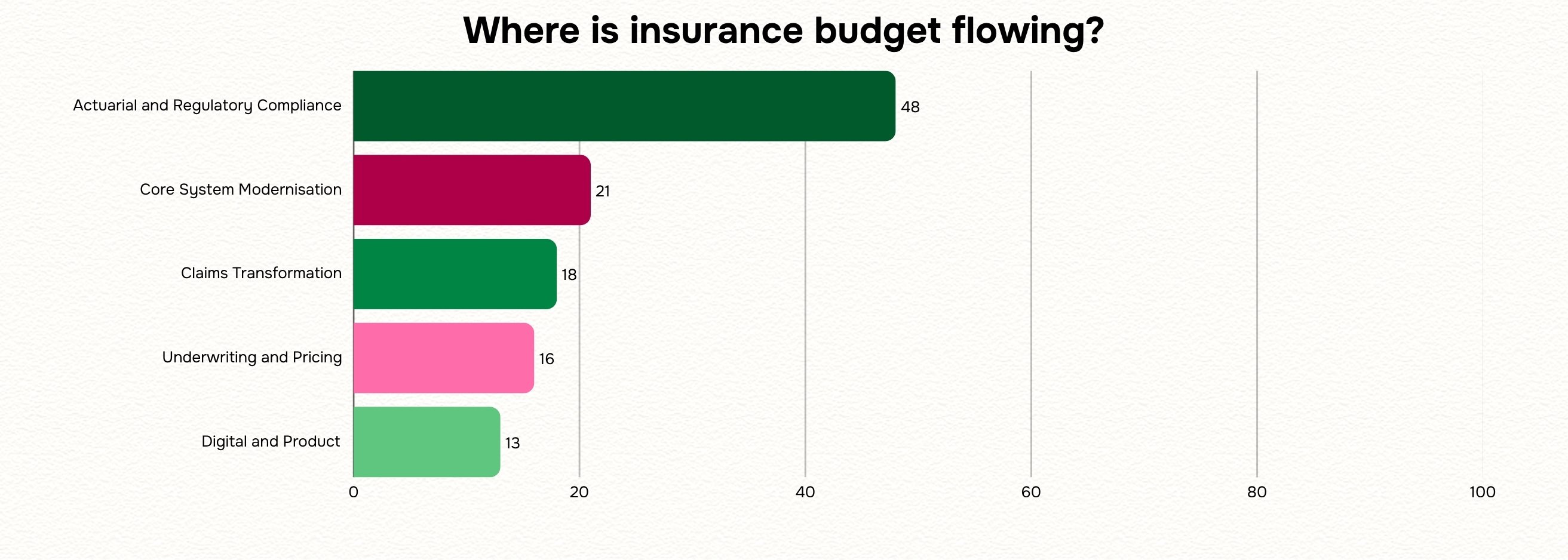
Actuarial and regulatory compliance (48% of engagements). Nearly half of all insurance advisory demand is actuarial and regulatory work. Insurers are not hiring for growth initiatives. They are hiring to stay compliant and keep the lights on. IFRS 17 ongoing compliance, reserving, valuation, and capital modelling dominate.
Core system modernisation (21%). Guidewire and Duck Creek implementations, policy administration replacements, and platform migrations. The specialists who understand both legacy logic and cloud-native architecture remain exceptionally rare, which is why this cluster represents one in five engagements despite the high complexity and cost of mobilising for it.
Claims transformation (18%). Claims processing, TPA integration, and straight-through processing. Traditional STP rates reach only 7%. AI-enabled STP reaches 70 to 90% for simple claims, with processing costs down 50 to 65% and cycle times compressed from 30 days to 7.5. AI leaders in claims achieve 6.1 times higher returns than laggards. Only 7% of insurers have scaled AI beyond pilots, not because the technology does not work, but because the specialists who can move it from proof-of-concept to production barely exist.
Underwriting and pricing (16%). Underwriting operations, pricing models, and risk assessment. Demand is concentrated in practitioners who combine technical pricing depth with conduct governance awareness.
Digital and product (13%). Customer journey redesign, digital channel build, and product development. Embedded insurance is reshaping distribution faster than most incumbents anticipated, creating demand for product managers who understand ecosystem economics.
What are the three capability battlegrounds in insurance?
.jpg?width=1260&height=450&name=Insurance%20(2).jpg)
Is actuarial and climate risk capability your binding constraint?
The actuarial shortage is the binding constraint across all three battlegrounds, not just one. Every adjacent capability, pricing accuracy, capital efficiency, regulatory standing, and the ability to deploy AI at scale, depends on actuarial depth that most insurers cannot produce or retain internally at the pace required.
Climate modelling has emerged as a distinct specialism within this already constrained pool. The emerging need is for actuaries who can model transition risk, physical risk, and ISSB-aligned scenarios simultaneously. Insured losses reached $100 billion in the first half of 2025 alone. Climate disclosure is now mandated across 17 jurisdictions. The hybrid profiles required, actuaries with climate science fluency, barely exist.
.jpg?width=1260&height=450&name=Insurance%20(5).jpg)
South African actuarial and cloud roles have seen 15 to 20% year-on-year rate increases. Yet many institutions have simultaneously implemented hiring freezes and reduced consulting spend, while regulatory and transformation deadlines remain fixed. Independent specialists have become the middle path: senior expertise without permanent headcount commitments or large-firm day rates.
Can your claims and policy administration capability deliver what AI promises?
Policy administration systems, often 20 to 30 years old, were built for annual renewal cycles, not real-time digital interactions. 75 to 80% of IT budgets are consumed by maintenance. The failure rate for digital transformation in insurance is consistent with the broader sector: 70% fall short of objectives.
Claims automation shows what is possible, and what is being left on the table. AI leaders in claims achieve 6.1 times higher returns than laggards. But only 7% of insurers have scaled AI beyond pilots. The specialists who can move these programmes from proof-of-concept to production are the same profiles in shortest supply across the entire sector.
Outsized demand data confirms the challenge: Guidewire and Duck Creek implementations, policy administration replacements, and claims transformation represent 21% of observed insurance engagements. The specialists who understand both legacy logic and cloud-native architecture are consistently the hardest to find and fastest to extend once placed.
Are you positioned to capture embedded insurance or be displaced by it?
Embedded insurance, coverage integrated at the point of sale by non-insurers, could reach $800 to $950 billion by 2030 to 2032, potentially representing one third of all insurance transactions by 2028. Amazon, Shopify, Uber, Grab, and Booking Holdings have all integrated insurance offerings. Customer acquisition costs fall up to 75% through embedded channels. Purchase intent increases 25% when coverage is offered at point of sale.
For incumbents, this creates a capability vacuum. Embedded insurance requires API-first product architecture, ecosystem partnership management, and real-time pricing capabilities that traditional insurers lack. 31% of policyholders remain dissatisfied with claims experience, with 60% citing settlement speed. Policyholders now expect instant payouts mirroring real-time banking rails.
.jpg?width=1260&height=450&name=Insurance%20(9).jpg)
The product managers who understand ecosystem economics and the integration specialists who can execute are not produced by traditional insurance career paths. They are sourced from fintech and digital product backgrounds, and most prefer project-based careers over permanent roles in slow-moving incumbents.
How should insurance leaders deploy independent specialists?
The carriers achieving the highest transformation success integrate independent specialists into 30 to 50% of major programmes. This is not a workaround. It is a deliberate workforce architecture decision driven by the mathematics of the talent market.
In practice, this means standing up resilience frameworks in 12 to 14 weeks rather than waiting six months for a permanent hire who may never arrive. Deploying climate risk actuaries before disclosure deadlines rather than after. Unblocking core modernisation without suspending delivery while permanent hiring runs in parallel.
Four behaviours distinguish the insurers that extract the most value from independent specialists. They plan for flexibility before the deadline arrives, not after. They maintain relationships with two to three specialist talent partners who understand their business well enough to challenge the brief, not just fill it. They have fixed onboarding governance: pre-approved role categories, one to two day onboarding rather than three weeks of IT access requests. And they measure independent specialist performance by delivery milestones, not utilisation rates.
82% of organisations with formal flexible workforce strategies report meeting transformation milestones, versus 54% of those without.
What does the 2026-27 outlook mean for insurance talent?
The convergence of forces in insurance is sharper than in any other FS sector, and none of the underlying constraints will resolve themselves within the planning horizon most insurers are working to.
By 2026, 400,000 insurance professionals will exit the workforce. The accounting talent shortage running in parallel means finance functions are under comparable strain. IFRS 17, Solvency II, DORA operational resilience, and proliferating climate disclosure mandates all draw from the same finite pool of actuarial and risk talent. These are not sequential obligations. They are concurrent demands on teams already operating at capacity.
The organisations that outperform over the next two years are those treating this as a structural workforce design problem, not a recurring recruitment challenge. That means building curated talent pools before they are needed, separating stewardship roles from delivery roles in workforce plans, and accepting that the most critical capability may never be available as a permanent employee.
.jpg?width=2625&height=938&name=Insurance%20(12).jpg)
Summary
Insurance faces the most acute independent talent challenge in financial services. 92% of insurers report critical shortages. 48% of all advisory demand on the Outsized platform is actuarial and regulatory compliance work. The actuarial pipeline cannot be accelerated: it takes seven to ten years to qualify, and the profession has zero unemployment at the senior level across key markets. The carriers maintaining delivery momentum have stopped treating independent specialists as a contingency and started designing workforce models around them, integrating specialists into 30 to 50% of major programmes and building pre-qualified talent pools before the next regulatory deadline arrives. The question is not whether the capability gap exists. It is whether you have built the access infrastructure to close it faster than your competitors.
Need actuarial, claims, or regulatory capability at pace?
About the authors
Niclas Thelander is Founder & CMO of Outsized with 30 years' experience in financial services, including roles at Scandinavian bank SEB, KPMG, trade credit insurer Atradius, and FS PE investor LeapFrog Investments.
Anurag Bhalla is CEO & Southeast Asia Lead, formerly of Monitor Deloitte and Deloitte Digital, with eight years at insurer Legal & General across innovation, platforms, and emerging markets.
Johann van Niekerk is EMEA Lead, a qualified actuary with 15 years at Metropolitan Life and RGA spanning product, business development, and insurtech investment, and founder of RGA Ventures.