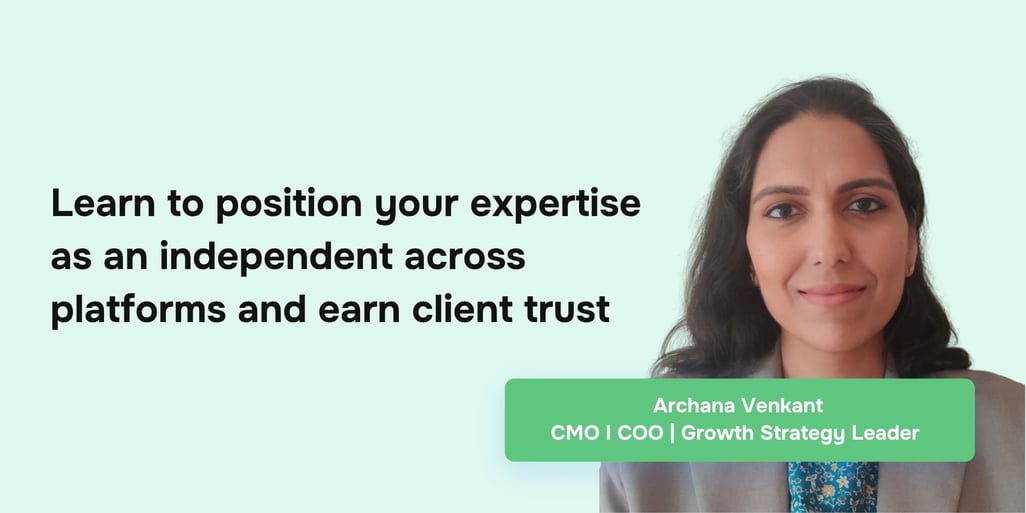
Watch: Learn to position your expertise as an independent and earn client trust
When you leave a senior corporate role and go independent, the assumption is that two decades of experience at respected firms will open doors. It often does not. The corporate world measures value through titles and the brands behind them. The independent market measures value through specific, demonstrable outcomes for specific problems. If you cannot translate one into the other, you will be trusted for advice but not hired for work.
In this session, Archana Venkat, a strategic advisor to B2B and professional services firms with two decades of experience at Deloitte, KPMG, HP and Trilegal, walks through the exact problem she faced when she went independent, the frameworks she used to identify her real niche, and the proof infrastructure and visibility strategy she built to convert her corporate experience into consulting engagements.
Watch the full recording here:
What you'll take away from the session:
-
Why corporate titles create an identity crisis when you go independent, and how to move from generalist credentials to specialist positioning
-
The EDJ framework (expertise, demand and joy) drawn from Ikigai principles, and how to use it to identify your sweet spot, diagnose when you are in the grindstone and find your way back
-
What a proof infrastructure is: the practice of translating confidential corporate achievements into specific, measurable, validatable outcomes that clients can understand and act on
-
A real example of how Archana's LinkedIn post about the GCC playbook generated six inbound enquiries and converted into paid projects, with a breakdown of the structural choices that made it work
-
Three ground rules for building LinkedIn visibility that compounds over time: solve problems rather than selling services, be consistent rather than occasional and stay where your clients actually are
-
How to price your services relative to the large consulting firms, and why the conversation about pricing is almost always more useful than the price itself
-
A 30-day action plan: identify your sweet spot, update your LinkedIn headline with one measurable outcome and commit to four pieces of specific, problem-focused content
Hit play and start converting your experience into evidence.
Why does a strong corporate track record not automatically translate into consulting clients?
Because corporate achievements are inherently opaque to the external market. They are protected by NDAs, measured through proprietary metrics and described in terms that mean something within an organisation but very little outside it. Archana makes a related point about India specifically, where full-time employment is often treated as a signal of quality, meaning that going independent can initially be perceived as having failed to hold a role rather than having chosen a different path. The deeper issue is structural: corporates value generalists who can grow with the organisation, while consulting clients hire for specific problems they cannot solve internally. If you have spent 20 years building breadth, you arrive in the independent market without the specialist positioning that clients are actively looking for.
How do you demonstrate the impact of your corporate work without breaching confidentiality?
By converting outcomes into patterns rather than proprietary numbers. Archana's example is precise: rather than disclosing a specific revenue figure from a client at Trilegal, she describes building a revenue channel equivalent to the book of business of five new partners. Any law firm partner reading that knows immediately what that number means in their own context, without Archana having disclosed anything that is confidential to her former employer. The same principle applies to percentage improvements in conversion rates, go-to-market timelines or adoption metrics. These can be shared in a one-to-one conversation, a pitch document or a private slide deck without entering the public domain. The key distinction is between sharing proprietary data and sharing the nature and scale of impact. The latter is almost always discussable.
What is the biggest mistake independent professionals make when building visibility on LinkedIn?
Pitching. Archana's clearest ground rule is to solve problems on LinkedIn rather than sell services. The reason is that services consulting is not a transactional sale. Nobody reads a LinkedIn post and decides to hire a strategic advisor. What LinkedIn does is build the trust, credibility and top-of-mind presence that means when someone has a problem that matches your expertise, your name is the one they think of. Content that pitches disrupts that trust-building. Content that genuinely helps, including sharing a specific framework, calling out a common mistake or making a prediction with clear reasoning, accumulates it. The secondary mistake is inconsistency: posting once after a thought-provoking event and then disappearing for two months. Authority is built through the repeated, reliable signal that you think carefully and visibly about a defined domain.
How should independent consultants approach pricing when they are just starting out?
Archana's recommendation is to anchor to comparable rates rather than working backwards from your income needs. Her own benchmark is the large consulting firms: if a client is willing to pay McKinsey, Bain or BCG X dollars per hour for a particular type of work, an experienced independent specialist should be positioned at 50 percent or above of that rate, because the pedigree premium of the brand is the primary thing the client is paying for with the large firm, not necessarily superior expertise. In practice, the most useful opening move is to ask the client directly whether they have a budget and what they would consider fair if they were in your position. That question almost always produces more useful information than a negotiation from a fixed price, and it shifts the conversation toward mutual respect rather than adversarial positioning.