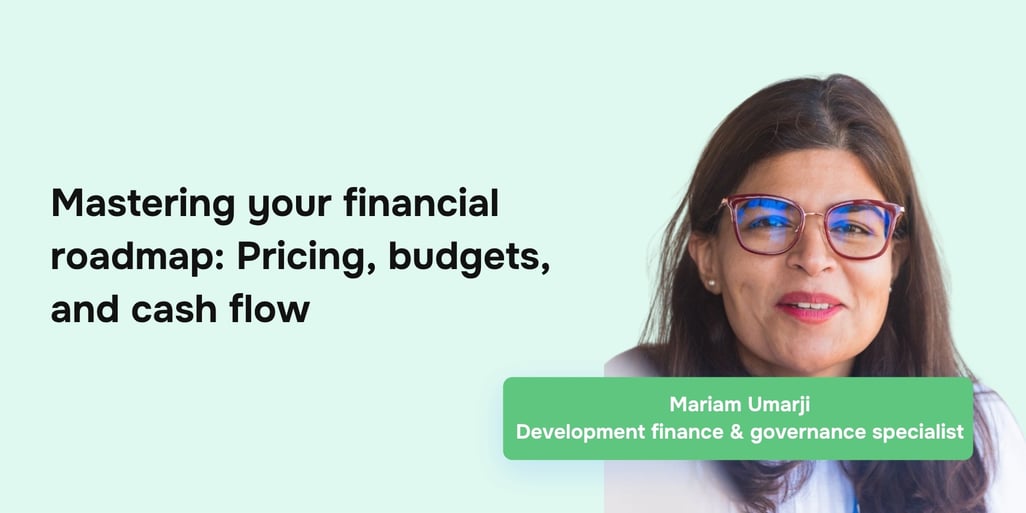
Watch: Mastering your financial roadmap - pricing, budgets & cash flow
Going independent changes your relationship with money in ways most professionals are not prepared for. You are no longer receiving a monthly salary into a single account, and the informal financial structure of employment disappears the moment you work for yourself.
In this session, Mariam Umarji, a chartered accountant and senior finance and development expert with over 15 years of experience advising governments and international organisations across Africa, Asia and Europe, shares how she manages her finances as a long-term independent consultant, and what she wishes she had known earlier.
Watch the full recording here:
What you'll take away from the session:
-
How to set your consulting rate when starting out, including how to benchmark against industry standards and why you should never price based on what you need to earn each month
-
The cues to look for when adjusting your pricing across different client types, sectors and contract structures, including the often-overlooked emotional cost of certain engagements
-
The practical difference between budgeting and expense tracking, and a bucket approach for managing personal, family and business costs as an independent professional
-
How to plan for dry spells, late payments and gaps between projects, including building buffers into project timelines and maintaining an emergency fund
-
How to separate your personal and business finances, set rules for transferring income across accounts and invoice consistently across concurrent projects
-
What to consider when it comes to retirement planning as an independent, including how legal requirements vary by country and why voluntary provisions require deliberate discipline
This session is for independent professionals at any stage who want to take a more structured approach to their finances without overcomplicating it. Mariam is direct, grounded and draws on years of real experience, not theory.
Hit play and hear from someone who has made financial management a core part of her independent practice, not an afterthought.

How do you set your consulting rate when you are starting out?
Mariam recommends two approaches. First, do the market intelligence: look at what large consulting and audit firms charge for comparable work and use that as your reference point, ranking your CV and experience against that standard. Second, base your estimate on the level of effort the assignment requires, factoring in that early in your career you will spend roughly double the expected time on delivery due to client feedback cycles and the learning curve. What you should not do is price based on what you need to earn each month. That is wishful thinking, not a pricing strategy, and no client will pay your rate because it matches your personal budget.
What is the difference between budgeting and tracking expenses, and why does it matter?
They are two different financial practices that are often confused. A budget is a forward-looking plan, typically covering three to six months or a year, that sets out what you expect to earn and spend. Expense tracking is the retrospective practice of recording what you have actually spent and comparing it against your budget. Mariam uses a bucket approach to budgeting, with separate allocations for family costs, education, health, insurance and business operating costs. The goal is to build in a safety margin that covers you during slow periods or when clients are delayed in paying, which is not a question of if but when.
How do you prepare financially for periods without work?
The core principle is to plan for downtime before it arrives, not during it. Mariam recommends building an emergency fund and contributing to it consistently, even in small amounts, during active project periods. She also builds buffers into her project estimates: if she expects 20 days of work, she quotes for 25 or 30, giving herself room to negotiate downward if needed. On the pipeline side, she works across multiple projects at different stages simultaneously, preparing proposals for new engagements while delivering on existing ones. This staggered approach means there is rarely a complete income gap, even when one project ends.
How should independent consultants approach retirement planning?
This depends heavily on your country's legal framework. If you are employed by a company, both you and the employer typically contribute to social security or a pension scheme, and you accumulate retirement entitlements over time. As an independent consultant, you are responsible for both contributions yourself, and in many jurisdictions, this is voluntary rather than mandatory. Mariam's position is that if it is not legally required, you still need to decide whether you want to do it, and that decision requires the same discipline as any other financial habit. The earlier you start, the more options you have later. Consulting a local financial or legal adviser on what is available and what applies to your specific situation is a practical first step.