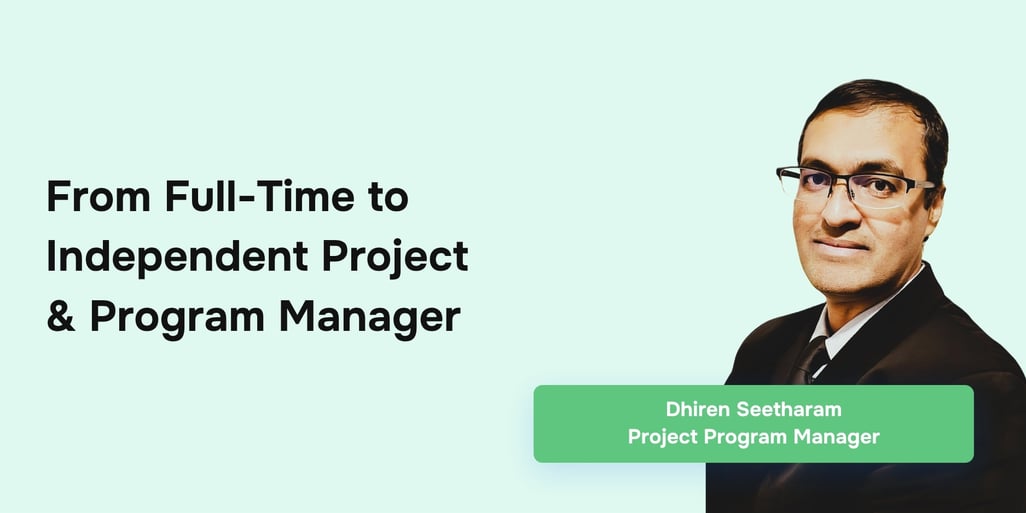
Watch: From full-time to independent project & program manager
For many independent professionals, the transition to contracting was not planned. It was a response to circumstances. What separates those who thrive from those who struggle is not the reason they made the move, but what they do with it.
In this session, Dhiren, a program and portfolio management specialist with over 22 years of experience, shares how a retrenchment at Deloitte during COVID-19 became the beginning of a sustained and rewarding independent career, including leading a finance transformation rollout across 11 countries for Old Mutual.
Watch the full recording here:
What you'll take away from the session:
-
How Dhiren moved from software engineering to programme management, and what prompted each transition in his career
-
The realities of making the shift to independent work during a period of extreme uncertainty, and how his professional network made it possible
-
A candid account of leading a fully remote, 11-country finance transformation programme, including the mental, relational and delivery challenges it involved
-
How to choose the right delivery methodology for each engagement, and why being prescriptive about frameworks often creates more problems than it solves
-
The habits and mindset shifts that have helped Dhiren stay consistent across engagements: staying in his lane, maintaining professionalism regardless of interpersonal dynamics and never becoming complacent
-
An honest look at the trade-offs of freelancing, from income uncertainty to the absence of sick leave, and how to hold both the highs and the lows with perspective
This session is for anyone considering independent work, currently navigating it or simply curious about what a long-term contracting career looks like from the inside.
Hit play and hear a straightforward, experience-led account of what independent consulting in financial services actually involves.
How do you transition into independent consulting after being made redundant?
Dhiren's entry into contracting came through a retrenchment at Deloitte during the pandemic rather than a deliberate plan. His advice is to activate your professional network immediately. Past colleagues directed him to his first contract at MTN, which sustained him through a period when permanent roles were scarce. The key lesson is to treat every engagement as a relationship investment rather than a transaction, because those same contacts become your pipeline for what comes next. A redundancy can be a genuine pivot point, but only if your network is already warm before you need it.
How do independent consultants manage large-scale, complex programs without permanent team backing?
Dhiren led an 11-country, fully remote finance transformation at Old Mutual as a contractor. His approach was to break the program into incremental components, build trust within a distributed team before pressing for delivery pace and earn the confidence of a program executive he had no prior relationship with. Large programs become manageable when you stop seeing them as one daunting whole and start identifying the pieces you already know how to do. Credibility compounds quickly once the first milestone is delivered to a high standard, and the team sees you can be relied on.
What are the real trade-offs of independent consulting versus a permanent role?
The upside is exposure and pace: variety across organisations, faster skill accumulation and higher earning potential. The trade-off is genuine uncertainty. Engagements end, sick days and leave are unpaid and job security does not exist in the way it does for salaried employees. Dhiren's framing is that both the rewarding and difficult periods are temporary, and neither should be mistaken for a permanent state. The sustainability of an independent career depends on your ability to provide for your circumstances without assuming any single engagement will last longer than it does.
How do you build credibility quickly as a new contractor joining an organisation?
Dhiren learned this at Old Mutual when his program executive challenged him for presenting an unfinished dashboard to the client. The feedback reframed his approach: as a contractor, every output signals whether the client made the right choice bringing you in. His advice is to arrive with high standards from day one, stay close to the operational detail so you can summarise accurately upward and treat early feedback not as a personal attack but as a calibration of what the role actually requires. That mindset is what builds the trust that sustains an engagement beyond the initial weeks.