Skip to content

Lessons that make Agile processes work in any complex environment

                                                            Agile handbook


Rolling out Scrum ceremonies and standing up new team structures is the easy part. The hard part is changing how decisions get made, how leaders behave under pressure and whether the people doing the work have real authority to act. These are not process problems. They are people and leadership problems. And almost no framework tells you how to solve them.

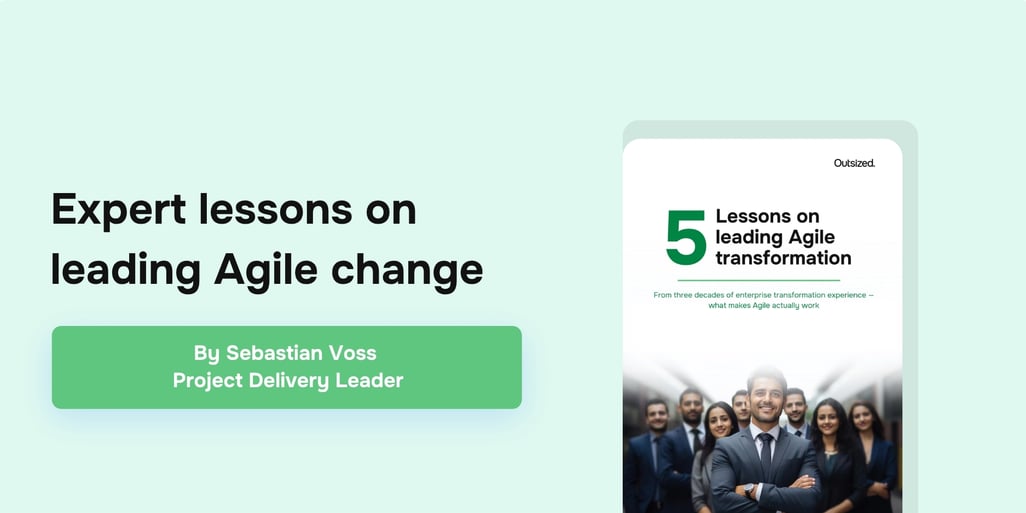
This handbook, drawn from a Community session with Sebastian Voss on enterprise agile transformation, distils three decades of experience across traditional and progressive organisations into five practical lessons. It is designed for independent professionals and senior leaders delivering change inside organisations that are not yet fully agile, and who need more than a framework to make it work.


What you'll take away from this handbook:

  • Lesson 1: Why agile is a behaviour change, not a process change, and what that means for middle managers who are the critical translational layer between strategic intent and operational delivery

  • Lesson 2: Why structure determines speed, including why too many approval layers kill agility regardless of which framework you are using, and how product-oriented structures build the accountability that project structures cannot

  • Lesson 3: Why process should enable rather than control, how to adapt frameworks to your actual context rather than force-fit teams into templates, and why measuring activity instead of outcomes is the most common mistake

  • Lesson 4: Why tools and AI do not fix organisational inefficiencies, and why digitising a broken process simply makes the problem move faster

  • Lesson 5: Why successful transformations start small and learn fast, and why strategy should evolve through practical experience rather than being designed entirely in advance

  • A do's and don'ts checklist covering what to start doing immediately and the five most common mistakes to stop making 

This is a practical reference document. Short enough to read in one sitting and specific enough to take straight into your next engagement.

Download the handbook and take the five lessons into your next transformation.  

Why is agile described as a behaviour change rather than a process change?

 Because installing new processes without changing how people think produces what the handbook calls agile as a cosmetic layer over old habits. Ceremonies run, boards get updated, but ownership and decision-making patterns stay exactly as they were. Middle managers are the critical translational layer here: when equipped and supported, they connect strategic intent to operational reality. When ignored, competing pressures collide at their level and slow everything down. 

What does it mean to think in products rather than projects?

 Projects are temporary and teams disperse after delivery. Products are ongoing, keeping teams accountable for outcomes well beyond launch. Product-oriented structures build long-term expertise and customer alignment that project structures simply cannot. The practical implication is that organisations need to question whether their funding and governance models, almost always built around projects, are compatible with how they want their teams to actually work. 

Why do tools and AI often make organisational problems worse?

Technology amplifies what is already there. Unclear roles, broken processes and poor communication do not get fixed by a new platform. They get more velocity. The handbook's principle is simple: simplify before you digitise. Complex or broken workflows that get digitised move complexity faster. Clarity comes first, then technology to enhance what is already working. 

What does starting small look like in an enterprise transformation?

A defined pilot with a willing team, a measurable objective and enough protection to allow different ways of working. The recommendation is to resist large-scale programme launches before anything has been tested. Small experiments allow teams to learn, build confidence and refine before scaling. Equally important: strategy should evolve from what those experiments reveal, not from a detailed multi-year plan written before the learning has happened.