Skip to content

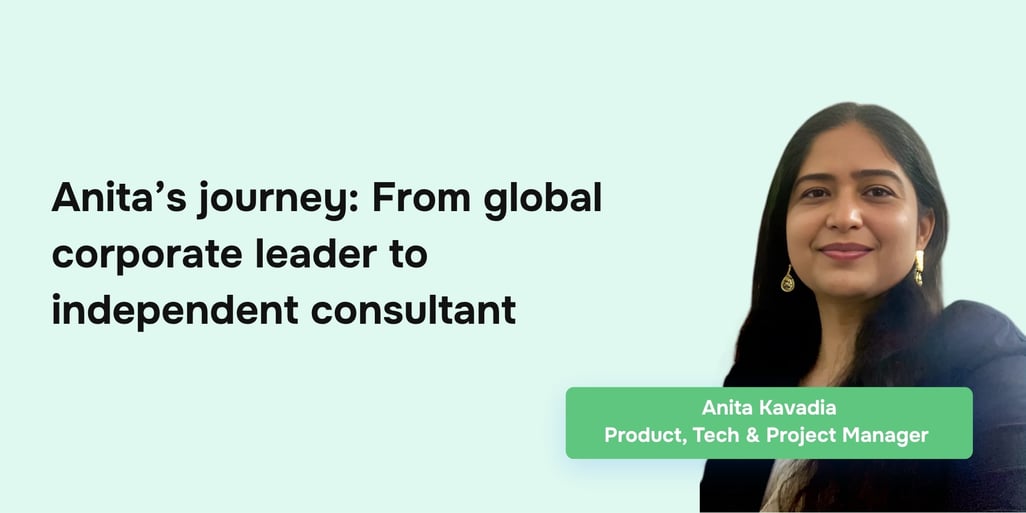
Watch: Anita's journey - from global corporate leader to Independent consultant

                                                            Anita thumbnail

Making the move from a senior in-house role to independent consulting is rarely a clean leap. For most people, it is the result of a slow accumulation of factors, until the moment arrives when staying put no longer makes sense.

In this session, Anita, a seasoned consultant with over 16 years of experience across banking, fintech and digital transformation, shares the unfiltered version of her journey, including her first project with BCG in Jakarta, the realities of working across fast-paced startups and large regulated banks, and the mindset shifts that have kept her in independent work for the past five years.

Watch the full recording here:

What you'll take away from the session:

  • How a mid-career inflection point, rather than a single dramatic decision, prompted Anita's transition from 12 years in corporate banking to independent consulting

  • The three things her time at Bank of America and BNP Paribas taught her about ways of working, communication across cultures and stakeholder alignment

  • How to adapt your delivery approach when moving between large corporate clients and fast-paced startups, where success looks very different

  • The honest challenges of independent consulting in financial services, from contract truncation to the constant expectation of being advisory-ready on AI and emerging technology

  • How to build client relationships quickly as an independent, using listening, empathy and transparency as the foundation

  • Anita's two non-negotiables for anyone considering the transition: have a clear goal for why you are doing it, and make genuine peace with uncertainty

 This session is for anyone who has considered independent consulting but is not yet sure whether the trade-offs are worth it.

 Hit play and hear one of the most candid accounts of independent consulting in financial services you will find.


How do you know when it's the right time to transition from a corporate career to independent consulting?

 Anita's view is that the decision is rarely triggered by one moment. It tends to be a combination of factors that build over time: a setback, a sense that your learning has plateaued, personal ambitions that a corporate structure cannot accommodate. Her advice is to be clear on your reason before you make the move, because that clarity is what carries you through the uncertainty on the other side. Trying things in between, a startup, a sabbatical, a smaller role, is a legitimate part of figuring it out rather than a detour. 

How do independent consultants build strong client relationships quickly?

 Anita's approach starts with listening rather than solutioning. Going in with a blank slate, understanding the client's real problem before mapping your expertise onto it, and communicating transparently at every level from the C-suite to the junior team. Clients do not always need the fastest answer. They need to trust that you understand their situation. That trust, built in the early days of an engagement, is what creates the flexibility and goodwill you will need when things inevitably get complicated. 

What are the biggest challenges of working as an independent consultant in financial services?

 Two stand out. The first is contract uncertainty: client strategies shift, company priorities change, and engagements can be cut short through no fault of the consultant. The second is the expectation of continuous upskilling. In financial services, the pace of change is fast and clients expect advisors to arrive current, on AI, on regulatory shifts, on emerging technology, with no learning curve built into the engagement. Anita's advice is to accept both as permanent features of the work rather than problems to solve, and to build your mindset around them accordingly. 

What are the real benefits of independent consulting compared to a traditional corporate career?

 Anita identifies three. The first is the speed and breadth of learning: two years in consulting can expose you to more than a decade in a single corporate function. The second is decoupling your sense of success from hierarchical progression, which she found more liberating than any promotion. The third is longevity: as long as you remain relevant and keep building expertise, there is no retirement clock. The trade-off is real uncertainty, but for professionals who are energised by variety, pace and ownership, the model tends to compound over time in ways a corporate trajectory does not.